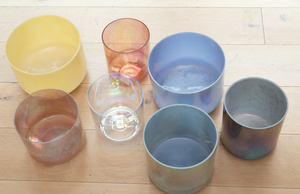
If you’ve been exploring Crystal Alchemy Bowls, you’ve probably seen names like Rose Quartz, Platinum, Amethyst, or Moldavite and wondered what they actually mean.
Are those materials really part of the bowl?
Do they change the sound?
Or are the names mostly symbolic?
The grounded answer is: it’s a blend of acoustics and meaning. “Infusions” are used to describe materials introduced during the manufacturing process, and they’re commonly associated with certain qualities. Some people relate to the energetic symbolism; others simply notice that different bowls have different tonal textures and emotional “colors.”
This guide breaks down what infusions are, how they may influence sound, and how to approach them in a clear, beginner-friendly way.
What “alchemy infusion” means (in plain language)
Crystal Alchemy Bowls are primarily made from high-purity quartz. “Alchemy” refers to a process where additional materials—often gemstones, minerals, or metals—are introduced during production (the exact method and amount varies by maker).
These added materials are typically described as the bowl’s infusion.
Two important notes:
Not all makers define infusion the same way. The term can refer to different processes depending on the manufacturer.
You don’t need to “believe” in anything to enjoy the bowls. Many people choose bowls purely by how they sound and feel.
How infusions may shape the sound
It helps to know what actually drives a bowl’s sound.
The strongest factors are usually:
the bowl’s size and shape
thickness and rim profile
how it’s played (mallet type, speed, pressure)
the room acoustics and where you are in the space
Infusions may influence the sound more subtly—often experienced as differences in:
warmth vs. brightness
complexity of overtones (how “layered” the sound feels)
how quickly the tone blooms
how long the resonance sustains
the overall character or “color” of the tone
Even when two bowls are the same musical note, these differences can make one feel grounding and earthy while another feels airy and expansive.
How infusions shape the experience (the meaning layer)
Alongside the acoustic differences, infusions are commonly associated with symbolic or energetic qualities. This is where personal resonance matters most.
Some people experience these associations as:
an emotional tone (soft, uplifting, steady, clarifying)
a felt quality in the body (warming, opening, settling)
a mood shift (calm, spacious, grounded)
Others simply enjoy the sound and let the meanings be optional.
Both approaches are valid.
Common infusion categories (and what they’re often associated with)
Below are a few commonly named infusion types and the qualities people often attribute to them. Think of these as guiding language, not rigid rules.
Gemstones and minerals
Often associated with emotional tone and subtle “heart/mind/body” themes.
Examples you may see:
Rose Quartz — softness, heart-centered presence, gentleness
Amethyst — clarity, calm, intuitive quiet
Azeztulite — expansion, brightness, uplift
Moldavite — transformation, intensity, acceleration
Precious metals
Often described as changing the bowl’s tonal “sheen”—more luminous, refined, or ethereal.
Examples:
Platinum — airy, calming, spacious
Gold (or “Ocean Gold”) — warm, harmonizing, stabilizing
Silver — clarity, brightness, cooling tone
Earth and grounding blends
Often described as steadying, heavy, anchoring, supportive during stress.
Examples:
Charcoal — grounding, settling, stabilizing
Other mineral-heavy blends may be described as “earthy,” “rooted,” or “protective”
Again: these are associations, not guarantees. The best guide is always how the bowl lands in your body.
How to choose infusions (without overthinking it)
If you’re selecting bowls for your own practice—or choosing a session where bowls are part of the experience—here are grounded ways to approach it.
1) Start with sound, then add meaning
Let your ears lead first. Choose the tone that feels most soothing or supportive. If the infusion meaning resonates too, that’s a bonus.
2) Notice your body’s response
When you hear a bowl that works for you, your system often shows it:
your breath slows
your jaw unclenches
your shoulders drop
your mind quiets
you feel more “here”
3) Match the bowl to the moment
Some tones feel supportive for grounding and recovery; others feel supportive for clarity and uplift. Your needs can change from week to week.
What if infusions feel too “woo” for you?
You’re not alone. A grounded way to relate to infusion language is to treat it like a poetic description of a sound’s character.
Just like you might describe music as:
warm
bright
heavy
spacious
tender
energizing
Alchemy infusion names can function similarly—an expressive way to communicate how a bowl tends to feel in the room.
You can fully enjoy Crystal Alchemy Bowls without engaging the symbolism at all.
Frequently asked questions
Are infusion effects scientifically proven?
Not in a definitive, standardized way. Sound healing research is growing, but infusion-specific claims are difficult to test because bowls vary widely and experiences are subjective. The most grounded approach is to treat infusions as a blend of sound character + symbolic language, and to trust direct experience.
Do all bowls with the same infusion sound alike?
No. Bowl size, note, shape, and playing technique can create major differences. Infusion is just one variable.
Can a bowl feel “too intense”?
Yes—especially for sound-sensitive people or during high-stress periods. It’s always okay to:
use earplugs
choose a gentler setting
sit up instead of lying down
step out if needed