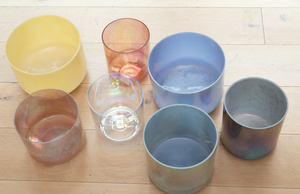
Crystal Singing Bowls in Research: What Early Studies Are Exploring
Crystal singing bowls are everywhere right now—studios, wellness spaces, retreats, and private sessions. People often describe them as calming, clearing, or deeply restorative. But a fair question remains:
What does research actually say about crystal singing bowls?
The honest answer is that crystal-bowl-specific research is still early. However, a small but growing set of studies is beginning to explore how quartz crystal bowl soundscapes may influence mood, stress, and the nervous system. This post offers a grounded overview of what’s being studied, what’s not yet proven, and how to think about the evidence responsibly.
Why crystal singing bowls are harder to study than you might think
Research on sound-based practices faces a few unique challenges:
There’s no single “standard” sound bath. Instruments, room acoustics, session length, and practitioner approach vary widely.
People respond differently to sound. One person feels deeply soothed; another may feel neutral—or even activated—depending on sensitivity, stress levels, or personal preference.
Blinding is difficult. In clinical research, it’s hard to “hide” whether someone is hearing a sound bath.
Outcomes are often subjective. Mood, relaxation, and emotional well-being are real outcomes, but they’re difficult to measure with perfect objectivity.
These challenges don’t mean sound healing “doesn’t work.” They simply mean we should interpret studies with care and avoid overclaiming.
What early studies are exploring
1) Mood and emotional well-being
One of the most relevant early pieces of research looks at quartz crystal singing bowls and mood. A pilot study examined the effects of relaxation music played on quartz crystal singing bowls in teenage males and explored mood-related outcomes.
Because it’s a pilot study, the findings are best viewed as an early signal—not a final conclusion. Still, it’s meaningful that crystal bowls are now being studied directly, rather than being lumped into “sound healing” as a broad category.
What this suggests:
Crystal bowl soundscapes may be associated with measurable changes in mood states for some participants, and they’re worthy of deeper research.
2) Stress and nervous system downshifting
Even when studies are not crystal-specific, researchers have explored singing bowl meditation and sound-based relaxation in ways that connect to stress reduction—especially around perceived stress, tension, and self-reported well-being.
A commonly cited study on singing bowl meditation found improvements in mood-related outcomes after a single session. This research is often used as part of the broader evidence base for why sound baths may support stress relief and relaxation, even though it does not focus only on crystal bowls.
Related study link (broader singing bowl meditation research):
https://pmc.ncbi.nlm.nih.gov/articles/PMC5871151/
Key takeaway:
Sound meditation practices (including singing bowls) are associated in research with reduced tension and improved mood in some populations—supporting what many people report anecdotally.
3) Autonomic regulation and HRV (Heart Rate Variability)
Some research explores singing bowls and physiological markers connected to nervous system regulation, including Heart Rate Variability (HRV). HRV is often used as a marker of autonomic flexibility and stress resilience.
A study examining Himalayan singing bowls explored emotion and HRV-related outcomes. Again, this is not crystal-specific—but it contributes to the bigger question of how sound-based meditation may influence the nervous system.
Related research link (HRV and bowls):
https://openaccesspub.org/international-journal-of-psychotherapy-practice-and-research/article/1282
Key takeaway:
Sound-based practices may influence physiological markers associated with stress and emotional regulation. More high-quality research is needed, especially on crystal bowls specifically.
4) Clinical and medical interest in sound therapy
Medical and psychology-facing sources have increasingly discussed sound therapy as a supportive approach for stress reduction, mood support, and relaxation—often emphasizing that it is complementary, not a replacement for medical care.
A helpful overview from UCLA Health:
https://www.uclahealth.org/news/article/what-sound-therapy-and-could-it-benefit-your-health
Key takeaway:
Mainstream health sources are paying attention, and the conversation is shifting toward nervous system support and relaxation—rather than mystical claims.
Why crystal bowls may feel different (and why research matters)
Crystal singing bowls are made primarily from quartz, and they’re known for:
long, sustained resonance
a clear, pure tone
layered overtones depending on bowl type and playing technique
From a research perspective, the most important point isn’t whether a bowl is “special.” It’s that sound and vibration can influence attention, breath, and the stress response. Research helps clarify what’s happening, who it supports most, and how to use sound responsibly.
What research does not prove (yet)
It’s important to stay grounded. Current research does not prove that crystal singing bowls:
treat or cure medical conditions
replace therapy, medication, or medical care
work the same way for everyone
What the research can support (more reasonably) is the idea that sound-based relaxation may influence stress and mood-related outcomes, and may support nervous system downshifting in some people.
A practical way to relate to the evidence
If you’re deciding whether crystal bowl sound baths are “worth it,” you don’t need to wait for perfect science.
A supportive approach looks like this:
Try a session (or a few) with curiosity, not expectation.
Notice how your body responds during and after.
Pay attention to sleep, mood, tension, and baseline stress over the next 24–48 hours.
If you’re sensitive to sound, use earplugs or try a smaller setting.
For many people, the most meaningful outcome is simple: feeling more regulated, more rested, and more able to meet life with steadiness.